Solutions

Challenges for People and Planet in the Carbon Capture Buildout
Climate Impacts, Community Harms, and the Gulf South Epicenter Carbon capture, utilization, and storage is expanding rapidly, driven by federal tax credits and public subsidies. Yet its climate benefits remain uncertain, while its risks fall heavily on communities already burdened by fossil fuel and petrochemical pollution. The Gulf South—especially Louisiana and Texas—has become the center…

Analysis of Innovative Environmental & Climate Policy Achievements 2025
Frontline communities kept up momentum for climate progress in 2025 despite rollbacks in climate funding, policy, and legislation. In partnership with The Solutions Project (TSP), we helped published a new report that assessed nine illustrative environmental and climate achievements led by or involving TSP grantees, spanning local and state victories across the country, including in…
The Call to Climate Justice: A Non-Partisan Field Guide to Connecting the Dots for Candidates & Voters
Surging energy costs and climate change are making it harder to afford a good life. Most people in America agree that the system is rigged and can relate to the feeling of uncertainty when it comes to the future. We must offer compelling explanations for these problems to build a broader, more engaged movement; the…
Accounting For Rural Energy Cost Burdens in Energy Affordability Policies
Authors: Jennifer Moon, PhD. and Arjun Makhijani, PhD. In conversations about energy affordability, the unique affordability challenges that rural communities face can be overlooked. Rural communities have lower median household income levels that make it harder to pay bills; are geographically isolated—creating challenges in energy delivery and access to assistance programs; and have higher rates…
Affording Our Energy Future: Perspectives to Power Change
Energy affordability has rocketed to the top of the American political agenda. At the gas station, filling up can easily cost over $50 per tank, and millions of people are barely scraping by after their monthly utility bills and rent/mortgage payments. But with all the attention, we have a unique opportunity to inform and influence…
One-Page Resource on Disparate Impact Changes
Disparate impact is a legal standard in federal civil rights law that allows policies that cause unequal harm to people to be challenged, even without proof of discriminatory intent. It was a key tool for challenging policies that disproportionately expose communities of color to pollution and climate risk, even without explicit discrimination. Because of changes…
Case Study: Oregon’s Hydrogen Public Notice Bill (SB 685)
The hydrogen blending controversy in Oregon first surfaced in West Eugene, where strong community outcry successfully halted a utility’s blending project. NW Natural, Oregon’s largest natural gas company, sought to begin blending hydrogen into residential pipelines in 2022. Soon after, residents in Southeast Portland discovered that NW Natural had begun blending hydrogen into their home…
Case Study: Door-to-Door Canvass in Northwest Indiana
Northwest Indiana has long been one of the most industrialized corridors in the country. The cities of East Chicago, Hammond, and Whiting, situated on the southern shore of Lake Michigan, are dominated by oil refineries, steel mills, and chemical plants. The BP Whiting Refinery, one of the largest in the U.S., anchors the area—bringing jobs,…
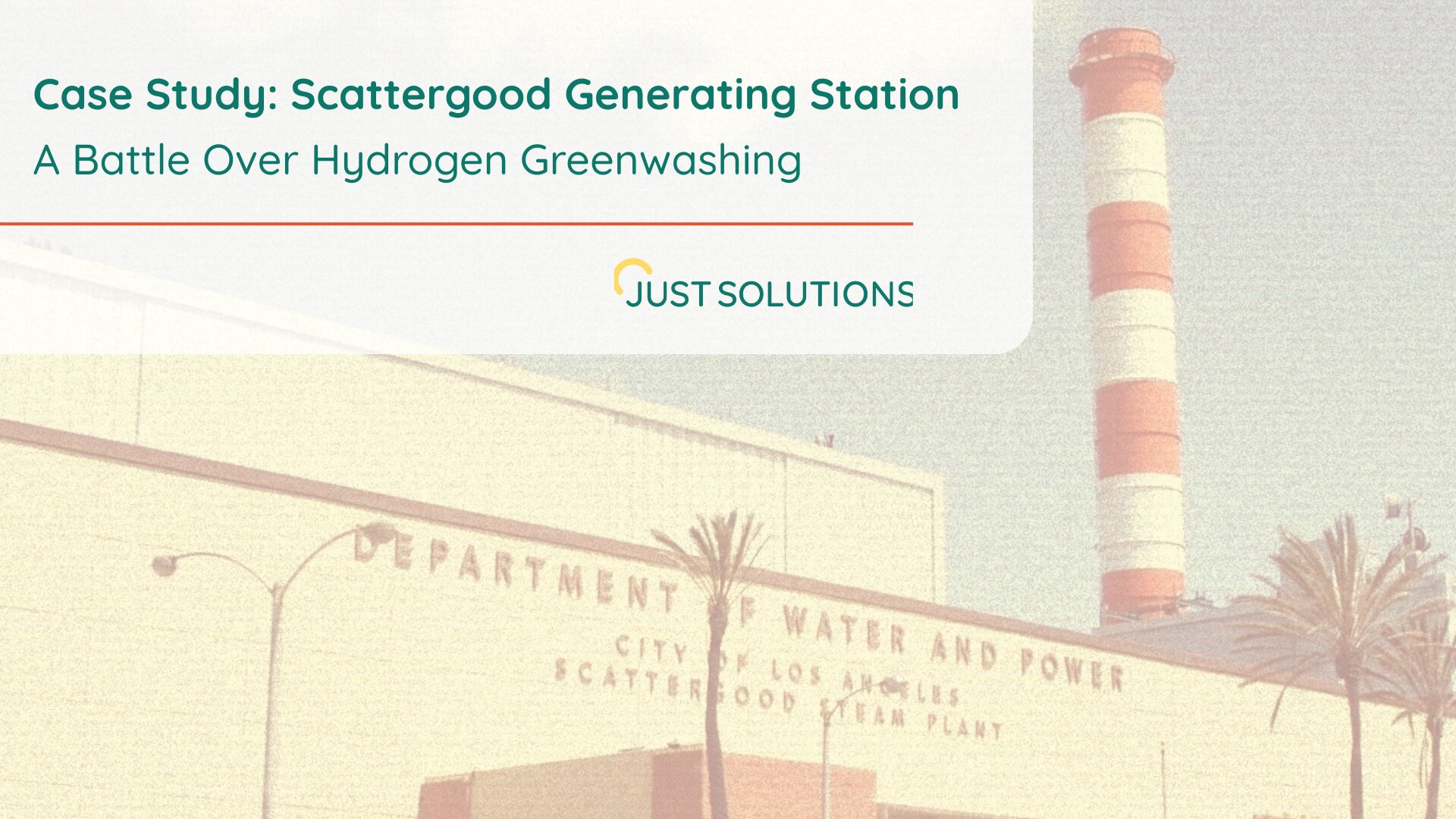
Case Study: Scattergood Generating Station – A Battle Over Hydrogen Greenwashing
The Scattergood Generating Station, located in Playa del Rey near Los Angeles International Airport, has become a defining case for understanding how fossil fuel industries are attempting to prolong the life of gas-fired power plants under the guise of “clean hydrogen.” The struggle around Scattergood illustrates both the power of grassroots environmental justice (EJ) advocacy…
Pathways For Action: Affording Our Clean Energy Future
Across the country, households are struggling to pay for mounting energy costs. From state to state, the costs of everything from mitigating wildfires to integrating new data centers loads are driving up utility bills. States now face an urgent need to address energy costs—and to do so in a lasting way that ensures long-term bill…