

Across the United States, average residential electricity prices increased 5% between 2024 and 2025, according to data just released from the U.S. Energy Information Administration.1 The inflation rate over the same period was 2.7%.2
Residential electricity prices outpaced inflation in 39 states and Washington DC—where prices rose an incredible 24% in 2025 for a total of 55% since 2022, due in part to grid modernization investments.3 New Jersey saw a 17% price jump and Maine more than 14%. Perhaps it should be no surprise, then, that New Jersey’s new Governor Mikie Sherrill’s first Executive Order upon taking office was to freeze the state’s electricity rates.4
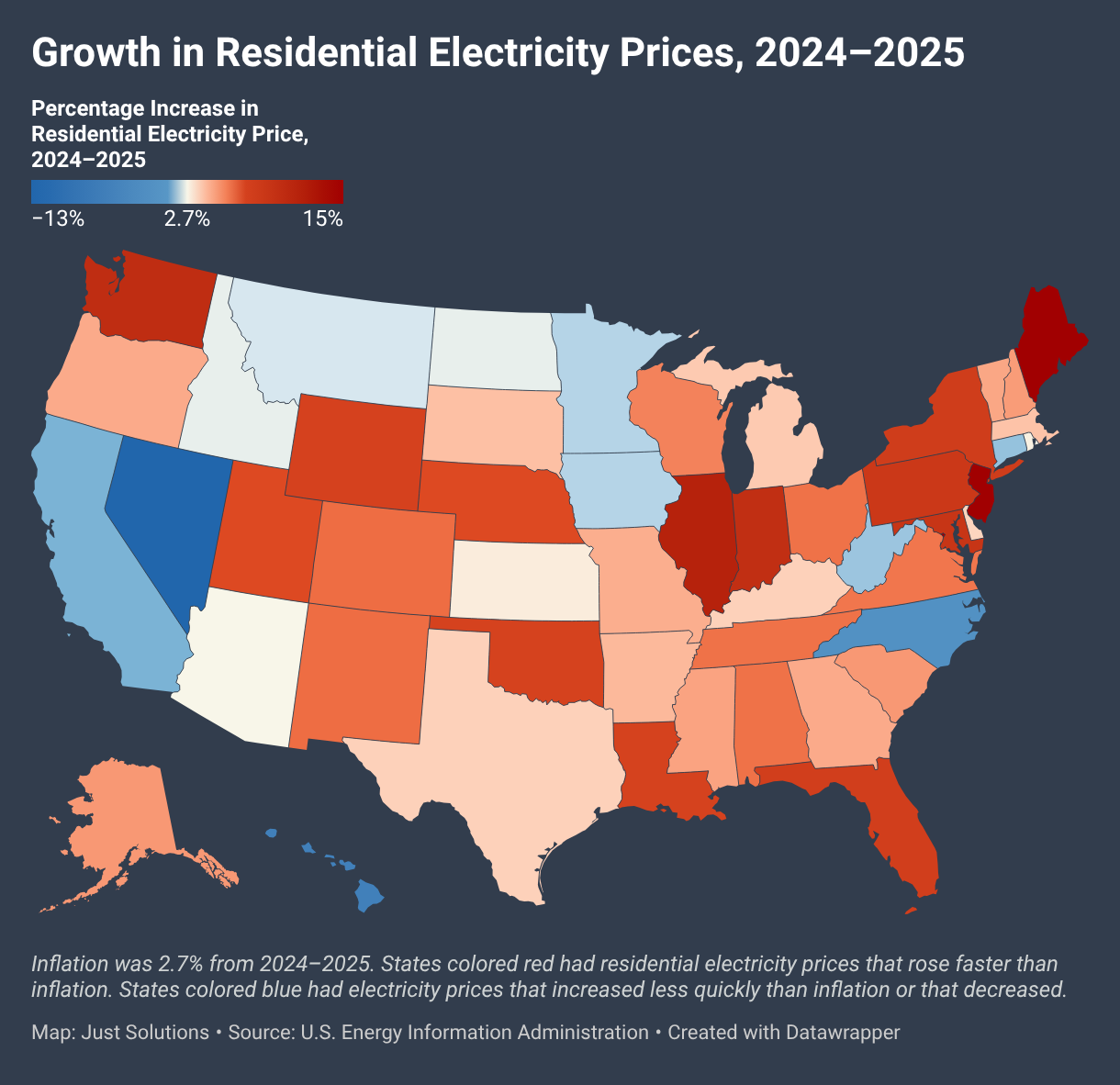
Not every state was impacted equally, however. Some of the states with the highest electricity prices in the country received a brief respite, including California, Connecticut, and Hawaii. Hawaii’s prices actually decreased about 5% in 2025, possibly due to a drop in fuel costs.5 Hawaii still has the highest residential electricity prices in the country, however, due in part to their reliance on imported oil to generate electricity, coming in at over 40 cents per kilowatt-hour compared to the national average of 17.3 cents per kilowatt-hour. California ranks second-highest for electricity prices—driven in large part by wildfire mitigation and recovery costs—and four New England states (including Connecticut) take the next slots. There can be significant in-state variation as well: California’s publicly-owned utilities, for example, have historically had much lower rate increases—and less exposure to wildfire risks—than its large investor-owned utilities.6
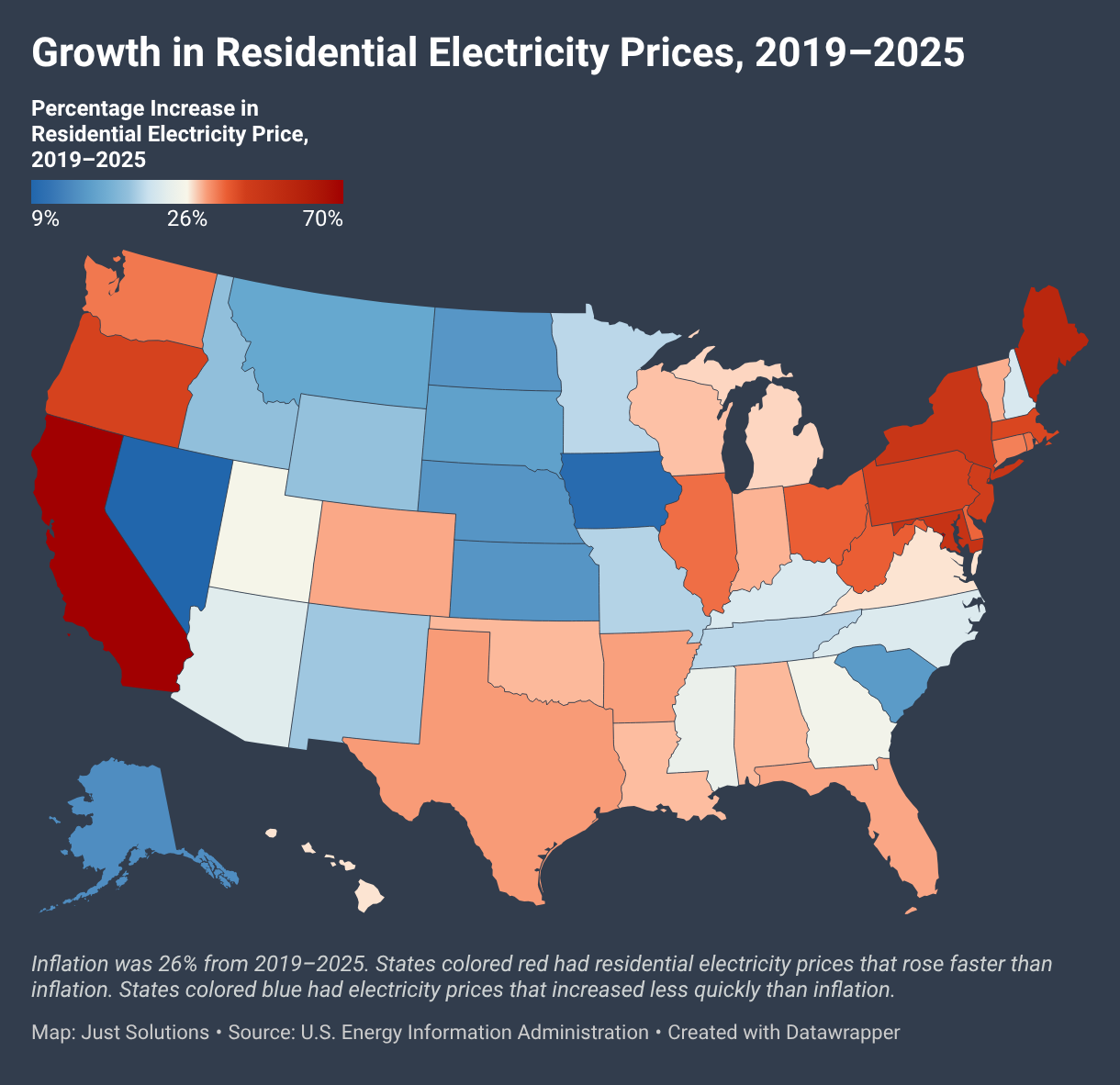
Year-on-year changes only tell part of the story, so we also looked at the growth in electricity prices from 2019 (before the pandemic hit, which caused some unusual impacts on energy use and prices) through 2025. When we previously looked at 2019–2024 data we found that national electricity price increases were largely driven by growth in California and the Northeast. While those trends continue to contribute to persistently high electricity prices in those regions, this last year has seen impacts expand into new states, in particular across the South and parts of the Midwest. Other parts of the Midwest have kept prices down, however—possibly due to the benefits of low-cost wind power in places like Iowa and the Dakotas. Price increases in the South may be reflecting the high costs of preventing and recovering from hurricane impacts—such as the compounding damage from Debby, Helene, and Milton which drove up 2025 electricity prices in Florida due to short-term recovery costs.7
Overall, residential electricity prices grew 33% from 2019–2025, compared to inflation at 26%.8 California has faced the highest overall growth in electricity prices over this period, at 70%, followed closely by Washington DC at 69%, Maine at 55%, and Maryland at nearly 49%. The drivers vary—rather than facing wildfires, for example, the mid-Atlantic (including Washington DC and Maryland) is instead struggling with a backlogged transmission operator, PJM, where it can take years to add new energy resources to the grid. Meanwhile, rapidly expanding data center loads (and forecasted loads) are further stressing available capacity and drove PJM’s capacity auction to record high levels last year.9 The coming year may see even higher energy bills: Powerlines reports that 2025 electric and gas utility rate increase requests were double that of 2024,10 and while not all of those have been approved, some of these rate increases will be reflected in 2026 bills.
After years of residential electricity prices rising faster than commercial or industrial prices, the trend switched last year. Although 2019–2025 commercial and industrial electricity prices increased on par with inflation, commercial rates increased 5.2% last year and industrial rates increased 6%, contributing to an overall electricity price increase of 5.3% from 2024 to 2025. It is unclear what is behind this change. Specifically, it is as yet unclear if expanding efforts to ensure that data centers, advanced manufacturing, and other industrial facilities pay their fair share for electricity are beginning to have an impact on industrial rates.
Electricity prices are only one of the factors contributing to unaffordable energy across the United States. Residential gas prices (which we’ll look at next week), and in some cases propane and fuel oil, also contribute to household energy costs for over half the households in the United States that use these fuels for space heating. People living in cold climates, or in houses with poor insulation and inefficient appliances, may use more energy overall than those living in energy-efficient buildings and temperate climates—driving up bills for those households no matter the electricity price. And persistently low incomes have left many households struggling to pay for their utility bills for decades, leaving them to face impossible trade-offs between paying for essentials such as energy, food, medicine, and rent. For these households, rising electricity prices are just one of many growing affordability challenges. Among the various financial conflicts, the failure to pay utility bills can contribute to housing insecurity. Many rental contracts require tenants to stay current on their utility bill payments. Inability to pay electricity bills also leads to millions of electricity shutoffs each year. For those whose rent is supported by the federal voucher program (known as “Section 8” housing), electricity shutoffs can become grounds for eviction.11 These conflicts are intensified by rising rates.
The cold 2025–2026 winter in the Eastern part of the country is compounding these affordability challenges. For instance, National Fuel, which supplies natural gas in New York State, estimates that heating bills there will rise 16% in the current winter.12 Higher rates and much colder weather means that the needs for bill payment assistance are rising. For example, one Maryland utility, Pepco, recognizing these facts, sent out a reminder to its customers that programs to reduce bills, including “financial assistance” were available.13
The drivers of rising electricity prices vary from state to state, and so must the solutions. To explore some of the policy options states can adopt to rein in rising rates, increase energy efficiency, and ensure access to affordable, clean energy for everyone, check out our Energy Affordability Policy Library.
- U.S. Energy Information Administration. Electricity Data Browser. Accessed: February 24, 2026. ↩︎
- U.S. Bureau of Labor Statistics. CPI Inflation Calculator. Accessed: February 24, 2026.
↩︎ - Spiegel, A. (2026). Why D.C. utility bills are rising again this winter. Axios. ↩︎
- Governor Mikie Sherrill. Exec. Order No. 1. January 20, 2026. ↩︎
- Drewes, Paul. (2025). Hawaii Electric rates changing now, but what about the future? Island News.
↩︎ - Singh, M., Ong, A., & Sud, R. (2025). Wires and fire: Wildfire investment and network cost differences across California’s power providers. The Electricity Journal, 38(3), 107475. ↩︎
- Wiser, R., Barbose, G., Cappers, P., Deason, J., Forrester, S., Gorman, W., O’Shaughnessy, E., Hledik, R., Lam, L., and Yan, A. (2025). Factors Influencing Recent Trends in Retail Electricity Prices in the United States What do we know? Where are the gaps? Lawrence Berkeley National Laboratory. ↩︎
- U.S. Bureau of Labor Statistics. CPI Inflation Calculator. Accessed: February 24, 2026. ↩︎
- Howland, E. (2025). PJM capacity prices hit record high as grid operator falls short of reliability target. Utility Dive. ↩︎
- Powerlines. (2026). Utility Bills are Rising: 2025 Review. ↩︎
- Krieger, E. et al. (2025). Pathways for Action: Affording Our Clean Energy Future. Just Solutions. (p. 6) ↩︎
- Penque, Z. (2025). National Fuel forecasting increase in residential heating bills for 2025-26 season. MSN. ↩︎
- Pepco. (February 2026). Email to customers. ↩︎